The band shrinks every decade and the contract says so
Minimum musician counts are negotiated per house, per city, and the long argument over synthesisers and tracks is an employment dispute as much as an artistic one.
The number in the contract
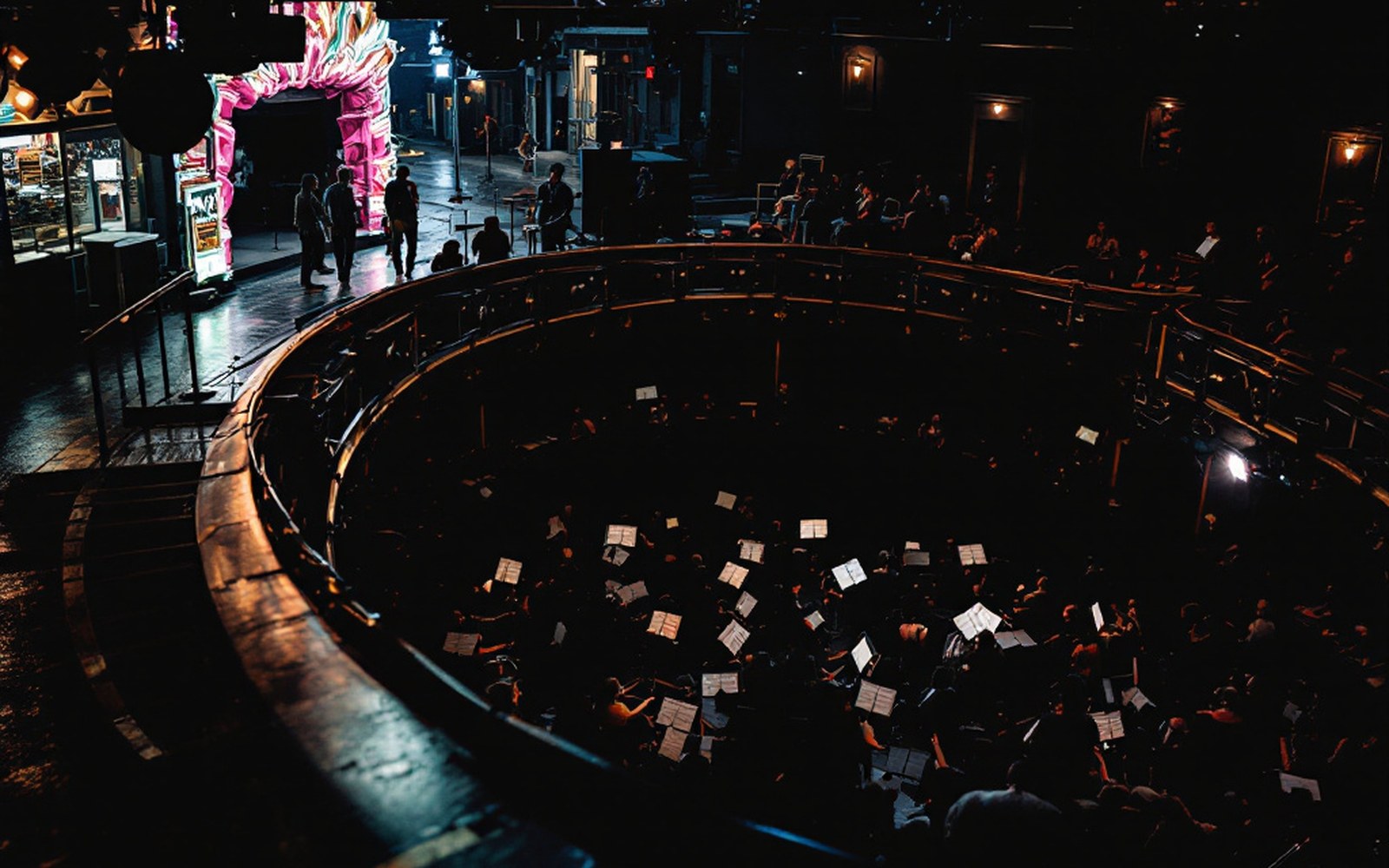
Walk into a Broadway musical and the sound washing over you is not purely the product of artistic choice. The size of the orchestra in the pit is partly determined by a contract — specifically, the collective bargaining agreement between a producing theatre and the American Federation of Musicians, the union whose Local 802 covers New York. Each house negotiates its own minimum: the number of live musicians who must be employed regardless of what the score requires. At the Palace Theatre, that number has historically differed from the minimum at the Winter Garden. A producer who wants to use fewer musicians than the house minimum either pays the missing players anyway — the industry calls them “walkers” — or negotiates a waiver.
That is not an abstract technicality. Walkers are musicians paid a full weekly salary to stay home. On a long-running show, the cost accumulates into the millions. Producers have always had an incentive to shrink the minimum, and the unions have always had an incentive to hold it. The whole history of the musical theatre orchestra is, in part, a history of that tension.
What synthesisers changed
The argument sharpened in the 1980s when digital synthesisers became capable of plausibly imitating orchestral instruments. A single keyboard player running a bank of samples could cover parts that had previously required a string section. The technology was not invisible — ears trained on live orchestral sound could usually tell — but it was close enough to matter commercially. Producers began proposing smaller ensembles supplemented by synthesisers; musicians and conductors began arguing, not always wrongly, that the result degraded the work.

The dispute came to a head on Broadway in 2003, when the Broadway League and Local 802 reached a new agreement after a protracted negotiation that included a brief strike. The outcome reduced minimum requirements in several houses while establishing rules about how electronic augmentation could be used. Jonathan Tunick, whose orchestrations for Stephen Sondheim productions had defined a standard of orchestral writing in the theatre, was among the voices arguing publicly that minimum reduction amounted to artistic as well as economic loss. The Broadway League has since published weekly data that makes the commercial stakes visible: a show with a smaller payroll has a meaningfully lower weekly break-even.
The West End followed a parallel but distinct path. The Society of London Theatre negotiates with the Musicians’ Union rather than the AFM, and house minimums on Shaftesbury Avenue have generally been lower than their Broadway equivalents for decades. Cameron Mackintosh’s large-scale productions of the 1980s and 1990s — at Her Majesty’s Theatre and the Palace Theatre among others — were capitalised partly on the assumption of specific orchestral sizes, and those sizes were built into the original production economics. When a West End show transfers to Broadway, the orchestration is frequently expanded to meet the higher union minimums, adding cost the London production never carried. That asymmetry is one reason a transfer rebuilds more than just the set.

Tracks, virtual orchestras and where the argument stands
The most recent front in the dispute is pre-recorded tracks — sequences played back from a computer during the show, sometimes blended invisibly with live musicians, sometimes used to fill out a sound that a reduced live band cannot produce alone. Several smaller Broadway houses and nearly all off-Broadway productions use some level of tracking. The union draws a firm line between augmentation and replacement: a track that substitutes for a musician who would otherwise be contracted is, in the union’s reading, a violation. Enforcement is difficult when the blend is sophisticated, and the argument about what counts as augmentation versus replacement has not been resolved cleanly in any contract cycle.
The minimum is not just a floor set by the contract. It is a negotiated bet on how long a show might run.
What every side agrees on is that the weekly gross sets the ceiling on what a production can afford to pay, and that the orchestra payroll sits near the top of the fixed cost column. A show running to capacity can absorb a large band; a show in trouble cannot. The minimum is therefore not just a floor set by the contract — it is a negotiated bet on how long a show might run, and on what the theatre, the union, and the audience will accept in place of a full orchestra.